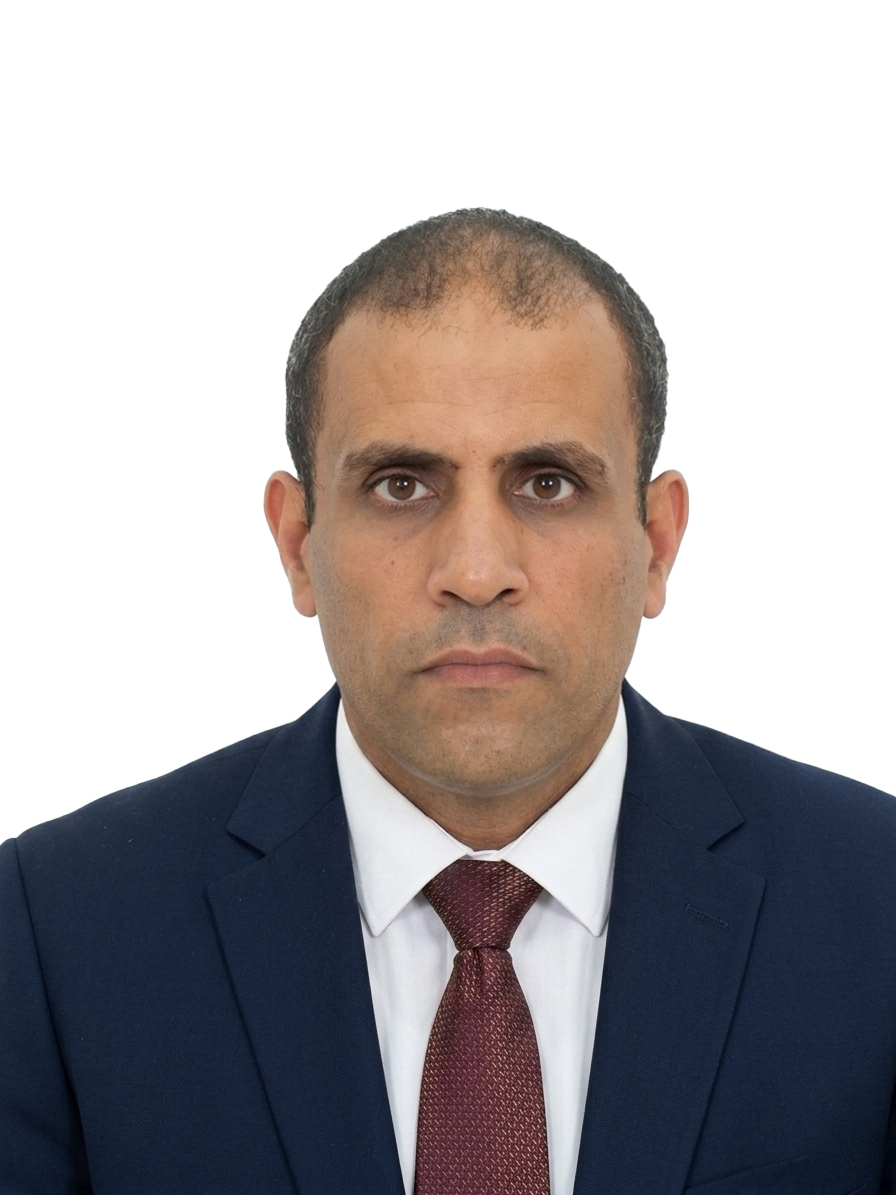
M. BOUCHALA Tarik

Prof

Directory of teachers

Department

DEPARTEMENT OF: ELECTRICAL ENGINEERING

Research Interests

Techniques de Controle Non destructif

Contact Info

University of M'Sila, Algeria

On the Web:

  • Google Scholar N/A
  • ResearchGate
    ResearchGate N/A
  • ORCID N/A
  • SC
    Scopus N/A

Recent Publications

2024-12-31

Detection of crack in railhead by using eddy current array probe

Passenger and rail personnel safety is paramount. Rail defects can lead to derailments, collisions, and serious accidents if not detected and addressed in time. A reliable and efficient rail network requires regular and effective infrastructure maintenance. Early defect detection allows for planning and carrying out necessary repairs before problems escalate. Maintenance and repair costs for railway tracks can be significantly reduced through continuous monitoring and prompt intervention when defects are identified. Early defect detection helps extend the lifespan of rails and minimize disruptions to rail traffic, thus improving the overall reliability and availability of the network. Traditional inspection methods, such as visual or ultrasonic checks, have limitations in detecting and characterizing rail defects. Eddy current imaging offers an innovative solution for non-destructive and more comprehensive rail inspection. This technique allows visualizing the rail surface and subsurface in detail, revealing defects that might be difficult to detect using other methods. Imaging provides richer data, enabling in-depth analysis of the size, shape, and location of defects, facilitating accurate assessment of their criticality. Early defect detection through eddy current imaging contributes to informed decision-making in maintenance planning, optimizing interventions and reducing safety risks. This innovative technology is particularly beneficial for high-traffic rail networks, where continuous monitoring and rapid defect detection are essential. In summary, eddy current imaging represents a significant advancement in rail defect detection and characterization, contributing to improved safety, reliability, and efficiency of the rail network.In this paper, a railway inspection system is developed based on the use of multiple sensors for detecting surface defects on the rails. They emphasize the importance of integrating different types of sensors, such as vision sensors, laser sensors, ultrasonic sensors, etc., to achieve a more comprehensive and precise assessment of the rail condition.
Citation

M. BOUCHALA Tarik, (2024-12-31), "Detection of crack in railhead by using eddy current array probe", [national] STUDIES IN ENGINEERING AND EXACT SCIENCES , Studies in Engineering and Exact Sciences

2024-12-12

Reconstruction of Defect Paths Using Eddy Current Testing Array 3D Imaging

In a world where the reliability and lifespan of industrial equipment are
critical, our research aims to go beyond the traditional limits of non-destructive testing.
We seek to achieve accurate detection and comprehensive imaging of defects in their
various forms by harnessing the capabilities of eddy current testing with multiplexing
technology on multi-element sensors. This approach allows us to save time and ensure
the quality of results. This paper presents a method for detecting and imaging different
defect paths on an aluminium plate. Our methodology involves the strategic deployment
of multi-sensor techniques specifically designed for eddy current testing. To address the
inherent challenge of mutual magnetic induction between these sensors, we employ the
alternating feed method, which is an advanced technology that ensures data integrity and
significantly accelerates scanning times. By combining this technology with multi-sensor
techniques, we capture signals that provide valuable insights into the presence of defects.
Additionally, we produce 3D imaging that enables us to trace their paths, regardless of
size. These preliminary results lay the foundation for future research aimed at accurately
characterizing and visualizing the shapes and dimensions of these defects, thereby
contributing to a more comprehensive understanding of defect behaviour.
Citation

M. BOUCHALA Tarik, (2024-12-12), "Reconstruction of Defect Paths Using Eddy Current Testing Array 3D Imaging", [national] Acta Universitatis Sapientiae , SAPIENTIA HUNGARIAN UNIVERSITY OF TRANSYLVANIA

2024-12-11

Efficient Eddy Current Detection of 3D Cracks Through Probe Signal analysis

The study of 3D eddy current is non destrucWve testing system for cracks characterization
using finite element method requires a great amount of computing time and memory space. In this
article, we have validated the developed model and then determined directly the crack length by
analyzing the complete signal. Afterwards, we have extracted from the complete sensor sweep
signal the maximal amplitude that we have exploited to estimate the crack depth.
Citation

M. BOUCHALA Tarik, (2024-12-11), "Efficient Eddy Current Detection of 3D Cracks Through Probe Signal analysis", [international] 1st International Conference on Water, Energy, Environment and Materials Engineering , Ouargla

2024-12-10

A Runge-Kutta Method for Optimizing Defect Depth in Multilayer Structures

This study presents an advanced optimization approach based on the Runge-Kutta algorithm to estimate the depth of internal defects in multilayer structures. The method is distinguished by its rapid and precise convergence toward optimal solutions, demonstrating its effectiveness in non-destructive testing applications. The analysis reveals high accuracy from the early iterations and a rapid reduction of errors, confirming the potential of this method to improve defect estimation in industrial environments, with superior accuracy and speed compared to traditional approaches.
Citation

M. BOUCHALA Tarik, (2024-12-10), "A Runge-Kutta Method for Optimizing Defect Depth in Multilayer Structures", [national] NATIONAL CONFERENCE ON COMPUTATIONAL ENGINEERING, ARTIFICIAL INTELLIGENCE AND SMART SYSTEMS NC2EAIS22024 , Tamanrasset, Algeria

Nondestructive Evaluation of Material Properties through Particle Swarm Optimization

This study uses Particle Swarm Optimization (PSO) to estimate material properties like conductivity and permeability from eddy current testing data, crucial for industrial reliability in aerospace and energy sectors. PSO effectively solves inverse problems, handling noisy or incomplete data. The results highlight PSO's role in improving the accuracy and reliability of material property estimation, advancing non-destructive testing methods.
Citation

M. BOUCHALA Tarik, (2024-12-10), "Nondestructive Evaluation of Material Properties through Particle Swarm Optimization", [national] NATIONAL CONFERENCE ON COMPUTATIONAL ENGINEERING, ARTIFICIAL INTELLIGENCE AND SMART SYSTEMS NC2EAIS22024 , Tamanrasset, Algeria

2024-11-17

Simulation of 3D Crack by Analyzing Probe Signal in Multilayer Structures Near Rivet Holes

Mainly, this paper presents experimental study of the detection of fatigue damages crack occurred in areas around the round head rivets due to the increased level of stress concentration. Hence, we have used a rotational eddy current differential probe because this kind of rivet perturbs Lift-off while using the usual sliding inspections methods. As predicted, the experiment results have shown that the defect can be detected with high sensibility even if the fastener is present. However, some geometrical parameters such as Lift-off and the distance between the rivet and the probe axis must be kept constant. On other hand, the noise signals became neglected, in aircraft routine inspection, when the Lift-off and the distance between the probe and the rivet are minimal.
Citation

M. BOUCHALA Tarik, (2024-11-17), "Simulation of 3D Crack by Analyzing Probe Signal in Multilayer Structures Near Rivet Holes", [national] colloque sur inductique , Université de Msila

2024-10-02

Defect characterization from magnetic field leakage signals in petroleum and natural gas pipelines

Pipelines transport invaluable energy resources such as crude oil and natural gas over long distances. The integrity of the piping system in terms of safety of the process is then of high importance. However, pipes are prone by time to defects that may degrade their properties and lead to failures. In this paper, we study the effect of defect parameters on the magnetic field leakage captured by Hall sensors operating along the pipe. In fact, the obtained results show that the defect parameters influence directly the MFL amplitude and shape. For this reason, the inversion problem allowing us to reconstruct the defect from the MFL signals became fast and easier in comparison to the deterministic and probabilistic algorithm inversion procedure. However, the simplified system cannot describe the real defects and the three-dimensional numerical study became necessary. In tank floor inspection domain, as our recent published work, we have studied the performance of defect shape reconstruction from MFL array sensor imaging and depth estimation while using an iterative inversion method. Indeed, the first stage consists of determining the defect width and length from magnetic flux leakage mapping reconstructed from the recorded signals of the micro-integrated magnetic sensors. Then, after coupling Comsol and Matlab software, the defect depth is obtained by coupling the 3D finite elements method and a fast iterative algorithm recently developed. Consequently, the defect shape and size are obtained after a few iterations with high precision. Furthermore, this method of defect reconstruction and seizing can be extended for irregular defect shapes encountered in pipeline such as cracks and corrosion.
Citation

M. BOUCHALA Tarik, (2024-10-02), "Defect characterization from magnetic field leakage signals in petroleum and natural gas pipelines", [national] STUDIES IN ENGINEERING AND EXACT SCIENCES , STUDIES PUBLICACOES

2024-07-22

Numerical simulation and experimental studies of rotational eddy current detection of cracks around rivet holes

Multi-layered aeronautical structures, such as fuselage panels and wings, are composed of several layers of materials such as metal and composites. These structures are prone to damage such as corrosion, cracks and delamination between layers, which can compromise their structural integrity. Eddy current sensors are an essential tool for the inspection and preventive maintenance of multi-layered aeronautical structures, contributing to the safety and reliability of these crucial components. Differential-mode eddy current sensors are particularly well-suited for the inspection of multi-layer aerospace structures around dished-head rivets. The differential measurement improves the detection and characterization of defects in these complex geometries, which are prone to fatigue, corrosion, and other types of damage. The advantages of differential mode are improved sensitivity to small defects, elimination of lift-off variations (distance between the sensor and the surface), reduced electromagnetic interference and detection of defects around rivets, which are critical and difficult to access areas. This work deals with a study of the rotational differential sensor signal according to geometrical parameters of fastener holes defect. It is carried out by an eddy current nondestructive testing system implemented under COMSOL Multiphysics. Indeed, despite its rapidity, the results have shown that the sensor is sensitive to the hole defects when the distances Sensor/Rivet and Lift-off are reduced. As predicted, the experimental results have shown the presence of unsuitable signals caused by the additional Lift-off and the distance Sensor/Rivet. As a solution, these tow parameters should be reduced and kept constant in order to get a better defect signal.
Citation

M. BOUCHALA Tarik, (2024-07-22), "Numerical simulation and experimental studies of rotational eddy current detection of cracks around rivet holes", [national] STUDIES IN ENGINEERING AND EXACT SCIENCES , Studies in Engineering and Exact Sciences

2024-07-16

Inspection of aluminum sheets using a multi-element eddy current sensor: 2d and 3d imaging of surface defects of various sizes and internal defects at various depths

In the industrial sector, ensuring reliability and durability is of paramount importance. Our research aims to advance beyond conventional non-destructive testing methods by focusing on thorough defect detection and imaging. We utilize advanced, sensor-enhanced eddy current testing, featuring multiple elements arranged in a cutting-edge serial array. This innovative configuration addresses the issue of magnetic repulsion between sensor elements, thereby speeding up the testing process and ensuring precise results through both 3D and 2D imaging. This sophisticated approach allows us to more effectively characterize defects of varying sizes and depths in aluminum sheets. By meticulously collecting and analyzing data from the sensors, we can identify the appearance and nature of these defects with greater clarity. Our findings introduce a pioneering method for defect detection, highlighting the efficacy of our advanced testing technique. Our research underscores the potential of multi-element eddy current sensors in revolutionizing the inspection process. The ability to produce detailed 3D and 2D images of surface and internal defects represents a significant leap forward in non-destructive testing. This comprehensive imaging capability not only accelerates the detection process but also enhances the accuracy and reliability of defect characterization. By employing this state-of-the-art technology, we can detect even the smallest and most deeply embedded defects that traditional methods might miss. The precise imaging provided by our approach ensures that defects of various sizes and depths are accurately identified and characterized. This level of detail is crucial for maintaining the structural integrity and performance of aluminum sheets used in industrial applications. Our research demonstrates a groundbreaking approach to defect detection in aluminum sheets, leveraging the advanced capabilities of multi-element eddy current sensors. The innovative use of a serial array of sensors, combined with sophisticated data analysis techniques, allows for rapid, accurate, and detailed imaging of defects. These findings pave the way for improved reliability and durability in industrial applications, setting a new standard for non-destructive testing.
Citation

M. BOUCHALA Tarik, (2024-07-16), "Inspection of aluminum sheets using a multi-element eddy current sensor: 2d and 3d imaging of surface defects of various sizes and internal defects at various depths", [national] STUDIES IN ENGINEERING AND EXACT SCIENCES , Studies in Engineering and Exact Sciences

2024-06-28

Static eddy current imaging for nondestructive testing of aeronautical structures

Non-destructive testing (NDT) plays a crucial role in ensuring the safety and reliability of the structures used in aeronautics as it enables the detection of defects without damaging the parts examined. In the field of aeronautics, it is necessary to ensure the structural integrity of aircraft components. Vaulted head bolts are the most commonly used in this area to assemble multi-layered structures due to their strength and ability to maintain the structural integrity of aircraft. Examining these assembly areas can be challenging and present unique hurdles for non-destructive testing due to the shape and structure of the rivet, particularly its curved surface. This curvature can result in varying lift-off distances during surface scanning and alterations in the path of swirling currents near the rivet. Consequently, the response of vortex currents may vary, complicating the precise interpretation of test outcomes. In recent years, researchers have concentrated on devising advanced techniques for vortex testing to identify defects in complex structures, particularly those found in the aerospace industry. In this study, we have devised a model employing the finite element method (FEM) using COMSOL Multiphysics for non-destructive testing via 3D imaging utilizing a grid of multi-element vortex sensors distributed across multiple layers around the rivet, without necessitating the displacement of this grid. Our investigation, which involved analyzing various changes in lift-off distances for the sensor, demonstrated the accuracy of defect detection near the rivet, irrespective of the length and width of the defect. We propose a promising solution to tackle both the rivet's shape and the issue of probe displacement during testing. The sensors' non-displacement eliminates parasitic signals, preventing errors in signal interpretation, while multiplexed powering eliminates mutual inductance between adjacent coils.
Citation

M. BOUCHALA Tarik, (2024-06-28), "Static eddy current imaging for nondestructive testing of aeronautical structures", [national] STUDIES IN ENGINEERING AND EXACT SCIENCES , STUDIES PUBLICACOES

2024-05-31

Solving inverse problems in magnetic field leakage sensor array inspection of petroleum tank floor

The MFL method is a qualitative inspection tool and is a reliable, fast, and economical nondestructive testing method for tank floors. In this paper, before presenting the defect reconstruction procedure, we studied the effect of defect parameters on the magnetic field leakage measured by a single Hall sensor. As predicted, the study of each parameter has demonstrated that any variation in the geometrical parameters of the studied defect induce a significant influence on the MFL signal amplitude and distribution; for this reason, all the defect parameters must be determined precisely and prudently. After that, we have studied the performance of defect shape reconstruction from MFL array sensor imaging and depth estimation while using an iterative inversion method. Indeed, the first stage consists of determining the defect width and length from magnetic flux leakage mapping reconstructed from the recorded signals of the micro-integrated magnetic sensors. As a second step, after coupling Comsol and Matlab software, the defect depth is obtained by coupling the 3D finite elements method and a fast iterative algorithm recently developed. Consequently, the defect shape and size are obtained after a few iterations with a relative error of less than 2%; which makes this method very appropriate for real-time defect reconstruction and quantification. Furthermore, this method of defect reconstruction and seizing can be extended for irregular shape such as cracks and corrosion. In fact, this can be done while subdividing the affected area of non-constant depth into elementary zones of a constant depths. Then, while modifying the previous algorithm, we determine the corresponding depth of each zone.
Citation

M. BOUCHALA Tarik, (2024-05-31), "Solving inverse problems in magnetic field leakage sensor array inspection of petroleum tank floor", [national] STUDIES IN ENGINEERING AND EXACT SCIENCES , Studies in Engineering and Exact Sciences

2024-05-21

Non-destructive rapid defect testing around curved head rivets without displacement of eddy current sensors

In the field of aeronautics, it is essential to ensure the structural integrity of aircraft components. Non-destructive testing (NDT) plays a crucial role in ensuring the safety and reliability of structures used in aeronautics as it enables the detection of defects and imperfections without damaging the inspected parts. Domed head rivets are commonly used in aeronautics to assemble multilayer structures due to their strength and ability to maintain the structural integrity of aircraft. However, inspecting these assembly areas can be challenging and presents unique challenges in terms of non-destructive testing due to the curved surface of the rivet, resulting in lift-off variation during surface scanning and a modification of the trajectory of eddy currents near the rivet. This can lead to changes in the response of eddy currents, complicating the accurate interpretation of test results. In recent years, researchers have focused on developing advanced eddy current testing methods to detect defects in complex structures, such as those found in aeronautics. In this work, we propose a promising solution to address both the shape of the rivet and the probe displacement issue during testing. We have developed a model based on the finite element method (FEM) using COMSOL Multiphysics for non-destructive testing through 3D imaging using a matrix of multiplexed multi-element eddy current sensors distributed over multiple layers around the rivet without the need for the displacement of this matrix and capable of adapting to the variation in the diameter of the domed head rivet. The non-displacement of the sensors eliminates parasitic signals that can lead to errors in the interpretation of obtained signals, and the multiplexed powering of the sensors eliminates the mutual inductance effect between adjacent coils.
Citation

M. BOUCHALA Tarik, (2024-05-21), "Non-destructive rapid defect testing around curved head rivets without displacement of eddy current sensors", [national] STUDIES IN ENGINEERING AND EXACT SCIENCES , Studies in Engineering and Exact Sciences

2023-04-02

3D surface crack characterization by eddy current array image and a fast algorithm search

Nowadays, 3D eddy current nondestructive characterization of crack and corrosion defects while using ECA remains an industrial challenge because the obtained image permits to determine only the 2D defect shape. Consequently, this article is devoted to determine directly the crack length and width by eddy current images through sensor array. Afterwards, we extract the maximal impedance amplitude to estimate the crack depth while using the deterministic algorithm that we have recently developed. In fact, the obtained results have demonstrated the effectiveness and the reliability of the proposed method.
Citation

M. BOUCHALA Tarik, (2023-04-02), "3D surface crack characterization by eddy current array image and a fast algorithm search", [national] Journal of ELECTRICAL ENGINEERING , Sciendo

2022-10-23

DÉTECTION ET ÉVALUATION DES DÉFAUTS PAR LA TECHNIQUE DE FUITE DE FLUX MAGNÉTIQUE

La détection des fuites de flux magnétique est l'une des méthodes les plus utilisées pour l’inspection des pipelines et des réservoirs de stockage en matériaux ferromagnétiques. C'est une technique rapide de contrôle non destructif, elle utilise des capteurs magnétiques sensibles pour détecter la fuite du flux magnétique des défauts sur les surfaces internes et externes (les pertes d’épaisseur). Dans cette présentation on va mettre en évidence lors des simulations les différents paramètres influant sur le CND-MFL en appliquant un champ magnétique intense à l’aide d’un aimant permanent montée sur une plaque ferromagnétique en présence d’un capteur de champ à effet HALL inspectant la surface de cette plaque ferromagnétique présentant plusieurs types de défauts. Le modèle ainsi développé sera implémenté sous COMSOL multiphysics, nous considérons un défaut de surface, défaut de sous-surface et nous étudierons l'effet de la variation des caractéristiques géométriques du défaut, à savoir la longueur, la largeur et la profondeur sur l'induction magnétique lors du déplacement linéaire.
Citation

M. BOUCHALA Tarik, (2022-10-23), "DÉTECTION ET ÉVALUATION DES DÉFAUTS PAR LA TECHNIQUE DE FUITE DE FLUX MAGNÉTIQUE", [international] 2ème Séminaire Internationale de Génie Industriel et de Mathématiques Appliquées (SIGIMA'22) , SKIKDA, ALGERIA

2022-07-20

Non Destructive Testing by Magnetic Leakage Flux Applied to Ferromagnetic Parts

The non-destructive magnetic flux leakage control is very important because it is used for conductive parts and is based on the circulation of a magnetic field through the thickness of the tube. Magnetic Flux Leakage (MFL) is a corrosion and crack detection technique for ferromagnetic materials, which is mostly utilized in metal pipelines and tanks. It is based on the use of a strong magnet to magnetize the equipment's wall. The magnetic field "escapes" from the wall where there is corrosion or a lack of substance. The magnetic field leakage is measured using a magnetic flux detector situated between the magnet's poles. A magnetic flux detector placed between the poles of the magnet measures the magnetic field leakage. A magnetic field sensor is also used in the magnetic leakage flux approach to obtain a defect signature. The magnetic leakage flux test works by magnetizing the part to be examined with a magnetic field and then detecting the leakage of the generated field lines with a magnetic sensor. The principle of magnetic leakage flux testing is to magnetize the component to be tested with a magnetic field and detect leakage of the field lines caused by the presence of a defect in the part using a magnetic sensor.
In this work, we have given a description of the magnetic leakage flux sensors. We listed the Maxwell equations that regulate the MFL detection phenomenon, as well as a brief summary of the software utilized, COMSOL multiphysics, and a simulation result of this control. Last but not least, there's the transition from process to modeling. using a COMSOL multiphysics 3D simulation for low carbon and faulty steel sheet on the one hand, and for cylindrical parts with internal and exterior flaws on the other.
Citation

M. BOUCHALA Tarik, (2022-07-20), "Non Destructive Testing by Magnetic Leakage Flux Applied to Ferromagnetic Parts", [international] 3rd International Conference on Applied Engineering and Natural Sciences , Konya/Turkey.

2022

NON-DESTRUCTUVE EVALUATION OF MULTI-LAYER AERONAUTICAL STRUCTURES BY THE EDDY CURRENT METHODE

Non-destructive testing of electrically conductive materials often uses the eddy current (EC) method. In industrial applications, it is simple to use and reliable, but when the surface area of the items to be inspected is large, it can be costly. Eddy-current imaging systems are an example of a new generation of reliable and fast inspection systems. They have recently been designed to create EC images with high defect characterization capability. Eddy-current imaging systems are an example of a new generation of reliable and fast inspection systems. They have recently been designed to create EC images with a high defect characterization capability. It is produced using mechanical scanning techniques using a collection of separate coils that have been combined into a single probe to create a multi-element coil system. The use of a multi-element probe system allows a large surface area to be monitored, reducing the need for time-consuming scans to minimise the impact of mutuality.
Citation

M. BOUCHALA Tarik, kamel.belkhiri@univ-msila.dz, , (2022), "NON-DESTRUCTUVE EVALUATION OF MULTI-LAYER AERONAUTICAL STRUCTURES BY THE EDDY CURRENT METHODE", [international] 2nd INTERNATIONAL SEMINAR ON INDUSTRIAL ENGINEERING AND APPLIED MATHEMATICS , SKIKDA, ALGERIA

Etude pour la Réalisation d’une Sonde à Courants de Foucault Destinée pour la Détection de Défauts et la Caractérisation des Matériaux de l’Aéronautique

L’industrie aéronautique devient de plus en plus exigeant vis à vis des techniques de
détection et de maintenance, car une défaillance d’une partie d’un avion aura un
retentissement direct sur l’ensemble de l’appareil et mènera dans la majorité des cas à la
destruction de tout l’appareil après une catastrophe aérienne. D’autre part, les facteurs qui
sont à l’origine de l’apparition de défauts sont nombreux car les avions sont soumis en
permanence à des contraintes chimiques, thermiques et mécaniques. Actuellement, même si
les structures aéronautiques sont conçues de manière à supporter les contraintes citées en
faisant intervenir des structures multicouches rivetées avec des matériaux performants tels
que le Ti, Al, AU4G et l’Inox 304L, plusieurs endroits des avions reste le siège de l’apparition
de défaut : fissure dans les tôles et aux alentours des rivets, boulons... Ces situations ont
rendu l’inspection de telles structures un vrai challenge et nécessite une attention
particulière. Parmi les problèmes rencontrés, elle figure la caractérisation 3D d’une fissure
afin d’évaluer sa dangerosité et prendre une décision convenable. Dans cette thèse, nous
avons proposé une technique très robuste permettant de dimensionner en temps réel un
défaut parallélépipède apparaissant dans une tôle en Al, Ti, AU4G et Inox 304L. En effet, les
résultats obtenus ont montré la précision et la rapidité de la méthode associant le MEF et
l’algorithme déterministe développé. Le deuxième problème traité est la possibilité de la
détection d’un défaut dans un alésage en présence du rivet à tête ronde. En effet, la solution
proposée consiste à utiliser une sonde différentielle rotative dont la sensibilité est étudiée par
simulation numérique par MEF en 3D. Afin de valider la méthode proposée et étudier les
paramètres perturbateurs, nous avons réalisé un dispositif expérimental assurant la rotation
du capteur, l’acquisition et la représentation des signaux. Comme il a été prédit, certains
paramètres géométriques tels que le Lift-off et la distance entre le rivet et l'axe de la sonde
doivent êtres maintenus à des valeurs minimales et constantes afin d’obtenir que des signaux
utiles prédominant et réduire les signaux parasites.
Citation

M. BOUCHALA Tarik, ABBASSI Abderrahmane, , (2022), "Etude pour la Réalisation d’une Sonde à Courants de Foucault Destinée pour la Détection de Défauts et la Caractérisation des Matériaux de l’Aéronautique", [national] UNIVERSITE KASDI MERBAH OUARGLA

nondestructive evaluation of multilayer aeronautical structures by EC method

Le contrôle non destructif des matériaux électriquement conducteurs fait souvent appel à la méthode des courants de Foucault (CE). Dans les applications industrielles, elle est simple à utiliser et fiable, mais lorsque la surface des éléments à inspecter est grande, elle peut être coûteuse. Les systèmes d'imagerie par courants de Foucault constituent un exemple de nouvelle génération de systèmes d'inspection fiables et rapides. Ils ont récemment été conçus pour créer des images CF avec une capacité élevée de caractérisation des défauts. Elle est produite à l'aide de techniques de balayage mécanique en utilisant une collection de bobines séparées qui ont été combinées en une seule sonde pour créer un système de bobines multiéléments. L'utilisation d'un système de sondes multiéléments permet de contrôler une large surface, ce qui réduit le besoin de balayages longs. Pour minimiser l'impact de la mutualité
Citation

M. BOUCHALA Tarik, (2022), "nondestructive evaluation of multilayer aeronautical structures by EC method", [international] International seminar in industrial engineering and appllied mathematics , Algerie

eddy current system with multielement sensors and harmonic mode for detection of surface flaw in metal sheet

Le contrôle non destructif des matériaux électriquement conducteurs fait souvent appel à la méthode des courants de Foucault (CE). Dans les applications industrielles, elle est simple à utiliser et fiable, mais lorsque la surface des éléments à inspecter est grande, elle peut être coûteuse. Les systèmes d'imagerie par courants de Foucault constituent un exemple de nouvelle génération de systèmes d'inspection fiables et rapides. Ils ont récemment été conçus pour créer des images CF avec une capacité élevée de caractérisation des défauts. Elle est produite à l'aide de techniques de balayage mécanique en utilisant une collection de bobines séparées qui ont été combinées en une seule sonde pour créer un système de bobines multiéléments. L'utilisation d'un système de sondes multiéléments permet de contrôler une large surface, ce qui réduit le besoin de balayages longs. Pour minimiser l'impact de la mutualité
Citation

M. BOUCHALA Tarik, (2022), "eddy current system with multielement sensors and harmonic mode for detection of surface flaw in metal sheet", [international] International seminar in industrial engineering and appllied mathematics , Algerie

DÉTECTION ET ÉVALUATION DES DÉFAUTS PAR LA TECHNIQUE DE FUITE DE FLUX MAGNÉTIQUE

La détection des fuites de flux magnétique est l'une des méthodes les plus utilisées pour
l’inspection des pipelines et des réservoirs de stockage en matériaux ferromagnétiques. C'est une
technique rapide de contrôle non destructif, elle utilise des capteurs magnétiques sensibles pour détecter
la fuite du flux magnétique des défauts sur les surfaces internes et externes (les pertes d’épaisseur).
Dans cette présentation en va mettre en évidence lors des simulations les différents paramètres influant
sur le CND-MFL en appliquant un champ magnétique intense à l’aide d’un aimant permanent montée
sur une plaque ferromagnétique en présence d’un capteur de champ à effet HALL inspectant la surface
de cette plaque ferromagnétique présentant plusieurs types de défauts.
Le modèle ainsi développé sera implémenté sous COMSOL multiphysics, nous considérons un défaut de
surface, défaut de sous-surface et nous étudierons l'effet de la variation des caractéristiques géométriques
du défaut, à savoir la longueur, la largeur et la profondeur sur l'induction magnétique lors du déplacement
linéaire.
Citation

M. BOUCHALA Tarik, (2022), "DÉTECTION ET ÉVALUATION DES DÉFAUTS PAR LA TECHNIQUE DE FUITE DE FLUX MAGNÉTIQUE", [international] International seminar in industrial engineering and appllied mathematics , Algerie

Detection of Corrosion Defects of Train Rail by CND-CF

The detection and characterization of a defect is one of the problems most frequently encountered in numerous industrial sectors, aerospace and nuclear, because they were faced with the obligation to acquire the most advanced techniques for obtaining information of the physical and geometric characteristics of the different materials. In order to choose the best technique suited for an application, a number of criteria can be taken into account such as the ease of implementation of the technique and its low cost. Among these NDT techniques, the eddy currents (EC) one is the most commonly used industrially because of its environmental friendliness.
Citation

M. BOUCHALA Tarik, (2022), "Detection of Corrosion Defects of Train Rail by CND-CF", [international] International seminar in industrial engineering and appllied mathematics , Algerie

Eddy current system with multi-element sensors and harmonic mode for detection of surface flaws in sheet metal

Eddy current testing is among the most frequent electromagnetic processes used in the non-destructive assessment of conductive materials (ECT). The ECT principle is based on the electromagnetic induction phenomena. When a time-varying magnetic field interacts with an
examined component, eddy currents are formed in the material. The presence of a break in the investigated body can be detected by perturbing the eddy currents' course. ECT is widely used in a variety of applications, including material thickness measurements, proximity
measurements, corrosion evaluation, and material sorting based on electromagnetic characteristics. The detection and probable diagnosis of discontinuities is, however, the most common field of use at the moment. Natural fractures in steam generators, such as stress
corrosion cracks (SCC) and fatigue cracks (FC), are common.
In this paper, we will use stepwise array sensors, which record data by placing several eddy current sensors next to each other, in the current eddy technique of this study. Because of the multiplexing, which prohibits mutual induction between individual probes, the probes can be
analyzing conductive objects with a minimum number of scans, this technique saves a lot of time. Material ruptures and wear defects in the flight parts were explained in this way.
Citation

M. BOUCHALA Tarik, ABOURA Abderrahmane, Abdeslam AOUKILI, Merwane KHEBAL, , (2022), "Eddy current system with multi-element sensors and harmonic mode for detection of surface flaws in sheet metal", [international] international seminar in industrial engineering and applied mathematics (SIGIMA 2022) , Skikda

Journé dortorale en Electromécanique 2022

Journé dortorale en Electromécanique 2022
Citation

M. BOUCHALA Tarik, (2022), "Journé dortorale en Electromécanique 2022", [national] Journé dortorale en Electromécanique 2022 , Algerie

3D Imaging by Eddy Currents From Multi-Element Sensors in Multiplexed Mode Applied to Multilayer Structures Used in Aeronautics

The Eddy Current (EC) technique is widely used in the field of non-destructive testing of electrically conductive materials. It is easy to implement and robust in industrial applications, but it is relatively costly when large surfaces of parts to inspect are involved.
New reliable and quick testing systems are emerging such as eddy current imaging systems which have recently been developed to produce EC images with good defect characterisation performance. It is obtained by mechanical scanning procedures of a set of individual coils, grouped in a single probe and forming the multi-element coil system. The use of a multi-element sensor system makes it possible to control a large surface area and thus reduce the number of particularly time-consuming scans, and to minimise the effect of mutuality between adjacent coils, a multiplexed supply of the elements making up the multi-element sensor is carried out. It is in this context that our work "3D Eddy Current Imaging from Multi-element Sensors in Multiplexed Mode Applied to Multilayer Structures Used in Aeronautics" is situated.
Citation

M. BOUCHALA Tarik, (2022), "3D Imaging by Eddy Currents From Multi-Element Sensors in Multiplexed Mode Applied to Multilayer Structures Used in Aeronautics", [international] 1st International Conference on Engineering and Applied Natural Sciences , Turkey

Non destructive evaluation of multi layers aeraunotical structures by the eddy current methode

Advances in electronics have allowed the development of newer inspection techniques such as multi-element eddy current (MEC), which allows for increased reliability and repeatability of surface inspections compared to more traditional methods (Dye Penetrant and Magnetic Particle Inspection. Indeed, the possibility to adapt coil configurations and sequencing patterns allows users to optimize the acquisition chain for their application. In addition, by multiplying the active elements and exploiting advanced data processing capabilities, CFM solutions allow inspections to be performed faster, often with less surface preparation. They also offer additional benefits such as mapping-type imaging (e.g. 2D and 3D C-Scan displays), improved surface coverage, ease of deployment, and data archiving. Finally, in addition to defect detection, CFM technology can also sometimes provide quantitative dimensioning.
Citation

M. BOUCHALA Tarik, khebal merwane, Belkhiri Kamel, , (2022), "Non destructive evaluation of multi layers aeraunotical structures by the eddy current methode", [international] International seminar in industrial engineering and applied mathematics (SIGIMA 2022) , Skikda

Détection de défauts de corrosion de rail de train par CND-CF

The detection and characterization of a defect is one of the problems most frequently encountered in numerous industrial sectors, aerospace and nuclear, because they were faced with the obligation to acquire the most advanced techniques for obtaining information of the physical and geometric characteristics of the different materials. In order to choose the best technique suited for an application, a number of criteria can be taken into account such as the ease of implementation of the technique and its low cost. Among these NDT techniques, the eddy currents (EC) one is the most commonly used industrially because of its environmental friendliness.
Citation

M. BOUCHALA Tarik, Safer adib omar, , (2022), "Détection de défauts de corrosion de rail de train par CND-CF", [international] International Seminar in Industrial Engineering and aApplied Mathematics (ISEAM. 2022) , Skikda

2021

Imagerie 3D par Capteurs à Courants de Foucault Multiéléments des Surfaces Inspectées des Structures de Transport et de Stockage des Hydrocarbures.

A travers les recherches bibliographiques et les contacts que nous avons effectués avec les experts, nous avons remarqué que les appareils de détection par courants de Foucault conçus et commercialisés sont très sophistiqués et faciles à manipuler par un simple opérateur ; et cela grâce à l’imagerie 2D en temps réel des résultats d’inspection. Cependant, les résultats obtenus restent relativement qualitatifs car quelques paramètres essentiels restent inconnus. Pour cette raison, nous avons proposé de compléter certains résultats des scans en développant des algorithmes capables de caractériser en profondeur les régions affectées par les défauts de forme quelconque (corrosion, fissure, arrachement de matière, criques,..) et cela dans le cas des capteurs multiéléments alimentés en mode harmonique ou pulsé. De cette manière, les formes des régions affectées seront représentées en 3D (détermination de la profondeur de chaque point du défaut) ce qui va permettre aux contrôleurs d’évaluer leurs dangerosité. Dans les futurs travaux nous étendons cette technique pour la caractérisation d’un défaut aléatoire et la réalisation d'un dispositif de scan approprié. En effet, cela permettra de réduire le cout global des appareils importés.
Citation

M. BOUCHALA Tarik, (2021), "Imagerie 3D par Capteurs à Courants de Foucault Multiéléments des Surfaces Inspectées des Structures de Transport et de Stockage des Hydrocarbures.", [national] Workshop sur le partenariat SONATRACH-UNIVERSITE dans le domaine de la recherche et le développement , Boumerdes - Algerie

Eddy Current Probe Configuration for Full Rail Top Surface Inspection

In this paper, we have carried out an experimental study of the detection of top rail surface cracks. Firstly, we have highlighted the inability to inspect the entire rail head surface by a single sensor with a single scan. To overcome this inspection inability, we have proposed a multisensor system composed of three differential probes arranged within a specific configuration. The yielded results showed the efficiency and the robustness of the proposed configuration in the detection of cracks regardless its size, orientation and location.
Citation

M. BOUCHALA Tarik, AOUF ANOUARESSADATE, BACHIR ABDELHADI, , (2021), "Eddy Current Probe Configuration for Full Rail Top Surface Inspection", [national] Instrumentation Mesure Métrologie , International Information and Engineering Technology Association (IIETA)

2020

A COMPARATIVE STUDY OF OPTIMIZATION METHODS FOR EDDY-CURRENT CHARACTERIZATION OF AERONAUTICAL METAL SHEETS

This paper presents eddy current non-destructive characterization of three aeronautical metal sheets by deterministic and stochastic inversion methods. This procedure consists of associating the finite element method with three optimization algorithms (Simplex method and genetic and particle swarm algorithms) simultaneously determine electric conductivity, magnetic permeability and thickness of Al, Ti and 304L stainless steel metal sheets largely used in aeronautical industry. Indeed, the application of these methods has shown the performance of each inversion algorithms. As a result, while doing a qualitative and quantitative comparison, it was found that the Simplex method is more advantageous in comparison with genetic and particle swarm algorithms, since it is faster and more stable .
Citation

M. BOUCHALA Tarik, (2020), "A COMPARATIVE STUDY OF OPTIMIZATION METHODS FOR EDDY-CURRENT CHARACTERIZATION OF AERONAUTICAL METAL SHEETS", [international] Electronics and Energetics , FACTA UNIVERSITATIS

Eddy Current Characterization of 3D Crack by Analyzing Probe Signal and Using a Fast Algorithm Search

The study of 3D eddy current non destructive testing system for cracks characterization using finite element method requires a great amount of computing time and memory space. In this article, we have validated the developed model and then determined directly the crack length by analyzing the complete signal. Afterwards, we have extracted from the complete sensor sweep signal the maximal amplitude that we have exploited to estimate the crack depth
Citation

M. BOUCHALA Tarik, abbassi abderrahmane, Bachir Abdelhadi, , (2020), "Eddy Current Characterization of 3D Crack by Analyzing Probe Signal and Using a Fast Algorithm Search", [national] Russian Journal of Nondestructive Testing , springer

2019

Non Destructive Testing for a Multilayer Structure used in Aeronautics by Eddy Current Multi-Sensor System

The goal of non-destructive testing (NDT) is to determine a part's integrity without causing damage to it. Early diagnosis of a fault in high-risk fields like nuclear or aeronautics can save lives and save significant material and human losses.
In the field of non-destructive testing (NDT), eddy current imaging technology is based on multi-element sensors consisting of numerous eddy current probes eddy current probes positioned side by side for data collecting. The assembly of the is possible thanks to multiplexing, which avoids mutual inductance between the individual probes.
The ICFMM is designed for non-destructive evaluation of flaws in the area of rivets on aeronautical and other structures, and will allow defect characterisation using 3D pictures that represent impedance variation.
Citation

M. BOUCHALA Tarik, (2019), "Non Destructive Testing for a Multilayer Structure used in Aeronautics by Eddy Current Multi-Sensor System", [international] 1st International Conference on Engineering and Applied Natural Sciences on 10-13 May in 2022 at Konya/Turkey. , Turkey

Reconstruction Of 3D Defect Shape From Eddy Current Sensor Signal

The study of 3D eddy current non destructive testing system for cracks characterization using finite element method requires a great amount of computing time and memory space. In this article, we have validated the developed model and then determined directly the crack length by analyzing the complete signal. Afterwards, we have extracted from the complete sensor sweep signal the maximal amplitude that we have exploited to estimate the crack depth.
Citation

M. BOUCHALA Tarik, (2019), "Reconstruction Of 3D Defect Shape From Eddy Current Sensor Signal", [international] 2019 International Conference on Advanced Electrical Engineering (ICAEE) Alger, Algeria , Algerie

An Eddy Current Nondestructive Method for Crack Detection in Multilayer Riveted Structures

This paper puts forward a novel nondestructive method to measure the coating thickness of aeronautical construction materials (e.g. Al, AU4G, Ti and Inox 304L) using the eddy current. First, the forward model of the coupled electric field method was adopted to facilitate the eddy current measurement the coating thickness. The forward model was applied in Matlab simulation. Based on the simulation results, the authors examined the effects of nonconductive coating thickness on sensor impedance component such as amplitude, resistance and reactance. On this basis, an inverse algorithm was developed and coupled with the forward model, and verified through experiments. The results show that our method can measure the coating thickness of aeronautical construction materials rapidly at a high precision. The method has great potential for automated industrial applications.
Citation

M. BOUCHALA Tarik, (2019), "An Eddy Current Nondestructive Method for Crack Detection in Multilayer Riveted Structures", [national] Instrumentation Mesure Métrologie , IIETA

Nondestructive Eddy Current Measurement of Coating Thickness of Aeronautical Construction Materials

This paper puts forward a novel nondestructive method to measure the coating thickness of aeronautical construction materials (e.g. Al, AU4G, Ti and Inox 304L) using the eddy current. First, the forward model of the coupled electric field method was adopted to facilitate the eddy current measurement the coating thickness. The forward model was applied in Matlab simulation. Based on the simulation results, the authors examined the effects of nonconductive coating thickness on sensor impedance component such as amplitude, resistance and reactance. On this basis, an inverse algorithm was developed and coupled with the forward model, and verified through experiments. The results show that our method can measure the coating thickness of aeronautical construction materials rapidly at a high precision. The method has great potential for automated industrial applications.
Citation

M. BOUCHALA Tarik, (2019), "Nondestructive Eddy Current Measurement of Coating Thickness of Aeronautical Construction Materials", [national] Instrumentation Mesure Métrologie , IIETA

Fictitious electric conductivity modelling of eddy current evaluation of magnetic materials

This paper presents a new modeling approach of eddy current nondestructive evaluation systems containing magnetic materials. Originally, the proposed model is based on coupled circuits principle and the notion of equivalent current density. In order to make the model homogenous, we consider the current density as a state variable since this density is compatible with the representation of the magnetisation by equivalent currents. By introducing the fictitious electric conductivity approach, the sensor impedance is expressed according to magnetic tube or plate characteristics such as electric conductivity and magnetic permeability. An excellent concordance is achieved by comparing the calculated results to those of analytical ones. Regarding the mesh simplicity and the fast calculation, this method is very adapted for the resolution of the inverse problems for real time evaluation of the properties of magnetic materials.
Citation

M. BOUCHALA Tarik, (2019), "Fictitious electric conductivity modelling of eddy current evaluation of magnetic materials", [national] Nondestructive Testing and Evaluation , taylor and francis

2018

Imagerie 3D par Capteurs à Courants de Foucault Multiéléments des Surfaces Inspectées des Structures de Transport et de Stockage des Hydrocarbures.

A travers les recherches bibliographiques et les contacts que nous avons effectués avec les experts, nous avons
remarqué que les appareils de détection par courants de Foucault conçus et commercialisés sont très
sophistiqués et faciles à manipuler par un simple opérateur ; et cela grâce à l’imagerie 2D en temps réel des
résultats d’inspection. Cependant, les résultats obtenus restent relativement qualitatifs car quelques paramètres
essentiels restent inconnus. Pour cette raison, nous avons proposé de compléter certains résultats des scans en
développant des algorithmes capables de caractériser en profondeur les régions affectées par les défauts de forme
quelconque (corrosion, fissure, arrachement de matière, criques,..) et cela dans le cas des capteurs multiéléments
alimentés en mode harmonique ou pulsé. De cette manière, les formes des régions affectées seront représentées
en 3D (détermination de la profondeur de chaque point du défaut) ce qui va permettre aux contrôleurs d’évaluer
leurs dangerosité.Dans les futurs travaux nous étendons cette technique pour la caractérisation d’un défaut
aléatoire et la réalisation d'un dispositif de scan approprié. En effet, cela permettra de réduire le cout global des
appareils importés.
Citation

M. BOUCHALA Tarik, Abdelhak Abdou, , (2018), "Imagerie 3D par Capteurs à Courants de Foucault Multiéléments des Surfaces Inspectées des Structures de Transport et de Stockage des Hydrocarbures.", [national] Whorkshop Partenariat SONATRACH Universités , Algerie

Detecting Defects Using Non-Destructive Magnetic Flux Leakage Testing

Flux Leakage detection is one of the widest used methods for testing ferromagnetic pipes and
storage tanks. This is a rapid non-destructive testing technique. It uses sensitive magnetic field sensors to
detect leakage flux from internal and external surface defects (thickness loss). This paper will simulate an
NDT-3D MFL consisting of a permanent magnet powered magnetic circuit and a HALL effect field
sensor that examines the surface of a low carbon steel plate for some kind of defect. Therefore, the model
to be developed will be implemented according to the COMSOL Multiphysics software. We consider a
surface and subsurface defect and we will study the effect of variation in the geometrical properties of the
defect, namely length, width and depth of magnetic induction in straight transition.
Citation

M. BOUCHALA Tarik, (2018), "Detecting Defects Using Non-Destructive Magnetic Flux Leakage Testing", [international] 3rd International Conference on Applied Engineering and Natural Sciences , Turkey

Study of the use of eddy currents for defect detection on U50 rail

In this paper, we have successfully simulated the behavior of a non destructive testing by eddy currents (NDT-EC) system. that consisting of an absolute pancake-type sensor operating on the surface of a Vignol U50 rail under Comsol-multiphysics. This allowed us to highlight the need for the use of a multisensor system to ensure a complete scan of the surface. as well as the detection of longitudinal defect regardless of its position and orientation.
Citation

M. BOUCHALA Tarik, (2018), "Study of the use of eddy currents for defect detection on U50 rail", [international] APMAS 2018 8th INTERNATIONAL ADVANCES IN APPLIED PHYSICS & MATERIALS , Turkey

Etude de la Détection de Défauts de Rail U50 par Courants de Foucault Non Destructifs

Dans cet article, nous avons réussi à simuler le
comportement d'un système de CND-CF composé d'un capteur
absolu de type pancake opérant sur la surface d'un rail de type
Vignole U50 sous Comsol-multiphysics. Cela nous a permis de
mettre en évidence la nécessité de l'utilisation d'un système
multicapteurs afin d'assurer un balayage complet de la surface et la
détection de défaut longitudinal quelque soit sa position et son
orientation.
Citation

M. BOUCHALA Tarik, (2018), "Etude de la Détection de Défauts de Rail U50 par Courants de Foucault Non Destructifs", [national] 5eme colloque sur l'inductique , Algeria

Influence of Conductive Pollution on Eddy Current Sensor Signals

This paper presents a study of a surface crack detection in which the volume is filled by conductive substances due to the polluting environment. Hence, this investigation demonstrates by numerical simulation that electric conductivity is a crucial property that has to be added to the other defect geometrical characteristics in order to complete the developed models. Consequently, introducing the tolerance in percent in the measured impedance is necessary in some conditions. So, the obtained results demonstrate that the signal amplitude passes from 0 to 78% of the maximal amplitude when the defect conductivity rises from 0 to 0.5 Ms/m. On the other hand, the relative difference of the resistance partincreases according to defect volume. For example, for a defect of 0.3 MS/m, the relative difference of the resistance varies from 52 to 62% of the maximal amplitude when the defect depth varies from 0.5 to 2.25 mm. These results can be exploited to show the effect of the conductive substances occupying the crack volume. In fact, the controller using EC-NDT technique must take into consideration the presence of conductive polluting elements in the crack volume. So, this condition becomes primordial and necessary according to the degree and nature of pollution.
Citation

M. BOUCHALA Tarik, (2018), "Influence of Conductive Pollution on Eddy Current Sensor Signals", [national] Russian Journal of Nondestructive Testing , spriger

2017

LOGICIELS DE SIMULATION ET ENGINEERING

La conception assistée par ordinateur (CAO)comprend l'ensemble des logiciels et des techniquesde modélisation géométrique et physique permettantde concevoir, de tester virtuellemenà l'aide d'unordinateur et des techniques de simulationnumérique dans le but de réaliser des produitsmanufacturés et les outils pour les fabriquer.La CAO s'agit d'un outil informatique souventlié à un métier, fonctionnant en langage dit objet, etpermettant l'organisation virtuelle de fonctionstechniques. La CAO permet aussi de simuler et doncde tester virtuellement les produits avant de lesfabriquer.
Citation

M. BOUCHALA Tarik, (2017), "LOGICIELS DE SIMULATION ET ENGINEERING", [national] Journée scientifique 14 mars 2017 , Algerie

2016

Exciting Coil Optimization Criteria for Eddy Current Detection of Small Cracks Under Fastener Head

The aim of this paper consists of presenting optimization criteria of coil dimensions and the exciting field frequency in order to improving eddy current probe sensitivity for small and deep cracks under fasteners. To accomplish this task, we have studied the influence of coil inner radius, coil height and exciting frequency on probe sensitivity. Then, an algorithmic searching technique is applied to determine the optimal values of the previous parameters. Hence, the obtained results have revealed that the optimum inner radius corresponds exactly to the fastener head outer radius. Furthermore, it has been noticed that as well as the coil height is reduced while keeping the same number of turns, the probes sensitivity increases. Indeed, the use of stacking flat micro-coils is well adapted. In addition, the calculation of the optimum values of the frequency demonstrate that this parameter depend relatively on the defect position, its radial and vertical depth.
Citation

M. BOUCHALA Tarik, (2016), "Exciting Coil Optimization Criteria for Eddy Current Detection of Small Cracks Under Fastener Head", [national] journal of electrical engineering , journal of electrical engineering

Application of coupled electric field method for eddy current non-destructive inspection of multilayer structures

The development of fast and accurate method describing the electromagnetic phenomena intervening in eddy current non-destructive systems is very interesting, since it permits the design of reliable systems permitting the detection and the characterisation of defect in conductive materials. The coupled electric field method presented in this article can assume a large part of these objectives, because it is fast in comparison to the finite element method and easily invertible since the sensor impedance variation is an explicit function of target physical and geometrical characteristics. These advantages have motivated us to extend this method for multilayered structures, very interesting in aeronautic industry, by superposing the inductive effects in different layers. The impedance of an absolute sensor operating above three conducting layers will be calculated and compared to those obtained with finite element method. Afterwards, we shall exploit the model to study the effect of defect characteristics on the sensor impedance. Furthermore, regarding to the depth penetration effect, we shall make into evidence the necessity of accomplishing an optimal choice of the exciting field frequency during the inspection of multilayered materials. The essential importance of this method, besides of its rapidity, resides in its possibility to be extended to 2D irregular and 3D asymmetric configurations
Citation

M. BOUCHALA Tarik, (2016), "Application of coupled electric field method for eddy current non-destructive inspection of multilayer structures", [national] Nondestructive Testing and Evaluation , taylor and francis

2015

New contactless eddy current non- destructive methodology for electric conductivity measurement

In this paper, a new method of contactless electric conductivity measurement is developed. This method is essentially based on the association of the coupled electric field forward model, which we have recently developed, with a simple and efficient research algorithm. The proposed method is very fast because 1.3 s are sufficient to calculate electric conductivity, in a CPU of 2 GHz and RAM of 3 GB, for a starting research interval of 1.72–17.2 %IACS and tolerance of 1.72 × 10− 5 %IACS. The study of the calculation time according to mesh density and starting interval width has showed that an optimal choice has to be made in order to improve the rapidity while preserving its precision. Considering its rapidity and its simplicity of implementation, this method is more adapted, in comparison to direct current techniques using Van der Pauw geometry, for automated applications.
Citation

M. BOUCHALA Tarik, (2015), "New contactless eddy current non- destructive methodology for electric conductivity measurement", [national] Nondestructive Testing and Evaluation , taylor and francis

2014

STUDY OF THE INFLUENCE OF CONDUCTIVE DEFECT CHARACTERISTICS ON EDDY CURRENT DIFFERENTIAL PROBE SIGNAL

L’industrie aéronautique devient de plus en plus exigeant vis à vis des techniques de
détection et de maintenance, car une défaillance d’une partie d’un avion aura un
retentissement direct sur l’ensemble de l’appareil et mènera dans la majorité des cas à la
destruction de tout l’appareil après une catastrophe aérienne. D’autre part, les facteurs qui
sont à l’origine de l’apparition de défauts sont nombreux car les avions sont soumis en
permanence à des contraintes chimiques, thermiques et mécaniques. Actuellement, même si
les structures aéronautiques sont conçues de manière à supporter les contraintes citées en
faisant intervenir des structures multicouches rivetées avec des matériaux performants tels
que le Ti, Al, AU4G et l’Inox 304L, plusieurs endroits des avions reste le siège de l’apparition
de défaut : fissure dans les tôles et aux alentours des rivets, boulons... Ces situations ont
rendu l’inspection de telles structures un vrai challenge et nécessite une attention
particulière. Parmi les problèmes rencontrés, elle figure la caractérisation 3D d’une fissure
afin d’évaluer sa dangerosité et prendre une décision convenable. Dans cette thèse, nous
avons proposé une technique très robuste permettant de dimensionner en temps réel un
défaut parallélépipède apparaissant dans une tôle en Al, Ti, AU4G et Inox 304L. En effet, les
résultats obtenus ont montré la précision et la rapidité de la méthode associant le MEF et
l’algorithme déterministe développé. Le deuxième problème traité est la possibilité de la
détection d’un défaut dans un alésage en présence du rivet à tête ronde. En effet, la solution
proposée consiste à utiliser une sonde différentielle rotative dont la sensibilité est étudiée par
simulation numérique par MEF en 3D. Afin de valider la méthode proposée et étudier les
paramètres perturbateurs, nous avons réalisé un dispositif expérimental assurant la rotation
du capteur, l’acquisition et la représentation des signaux. Comme il a été prédit, certains
paramètres géométriques tels que le Lift-off et la distance entre le rivet et l'axe de la sonde
doivent êtres maintenus à des valeurs minimales et constantes afin d’obtenir que des signaux
utiles prédominant et réduire les signaux parasites.
Citation

M. BOUCHALA Tarik, Nabil Benhada, , (2014), "STUDY OF THE INFLUENCE OF CONDUCTIVE DEFECT CHARACTERISTICS ON EDDY CURRENT DIFFERENTIAL PROBE SIGNAL", [national] journal of electrical engineering , journal of electrical engineering

Novel Coupled Electric Field Method for Defect Characterization in Eddy Current Non-destructive Testing Systems

This article presents a defect modeling in eddy current non-destructive testing systems by using a new developed method called coupled electric field. It permits to improve qualitatively several models developed so far by many authors using coupled circuit methods that consider the defect only as loss of material. However, a defect can occur with a finite conductivity such as impurity, small burns and micro-solder. For this reason, this investigation consists of extending the coupled circuit method to the modeling of this kind of defects. The proposed approach consists of firstly considering the defect as an electric conductive volume and secondly changing the state variable presenting the electric current by the electric field one. This procedure permits expressing explicitly the impedance variation caused by the presence of an axi-symmetrical defect according to its characteristics. The comparison between the impedance variations calculated using finite elements method and the proposed one demonstrates a very good concordance. After this validation, the study covers also the influence of the defect shape and position on encircling probe impedance. This method is interesting since it permits a fully characterization of this kind of defects and facilitates the inversion process. Moreover, using a 3D finite element observation, this fast tool of simulation can be adapted for a fast phenomenological modeling of asymmetrical configurations
Citation

M. BOUCHALA Tarik, (2014), "Novel Coupled Electric Field Method for Defect Characterization in Eddy Current Non-destructive Testing Systems", [international] Journal of Nondestructive Evaluation , spriger

2013

Fast Analytical Modeling of Eddy Current Non-Destructive Testing of Magnetic Material

This article presents the modeling of non-destructive testing systems containing magnetic materials using a fast numerical method. Its main aim consists of correcting the half analytical expression of the impedance variation, formulated by some authors, caused by the presence of a conducting plate below of an absolute ferrite core probe. The obtained results of this correction are found to be consistent and satisfactory comparatively to those of finite element method. It also deals with the study the method rapidity by comparing its simulation time to that of the finite element method. As result, the proposed method is found to be very fast and a very short simulation time is required to calculate the sensor impedance. Indeed, for the studied system the coupled circuit simulation time is lower than 1.09 s. This study is appreciable, since it permits to solve quickly the inverse problem by expressing the physical and geometrical features of the material or defect according to the measured parameters. More importantly, this method is applicable to any axi-symmetric systems and can be adapted for the simulation of three-dimensional configurations.
Citation

M. BOUCHALA Tarik, (2013), "Fast Analytical Modeling of Eddy Current Non-Destructive Testing of Magnetic Material", [national] Journal of Nondestructive Evaluation , spriger

← Back to Researchers List