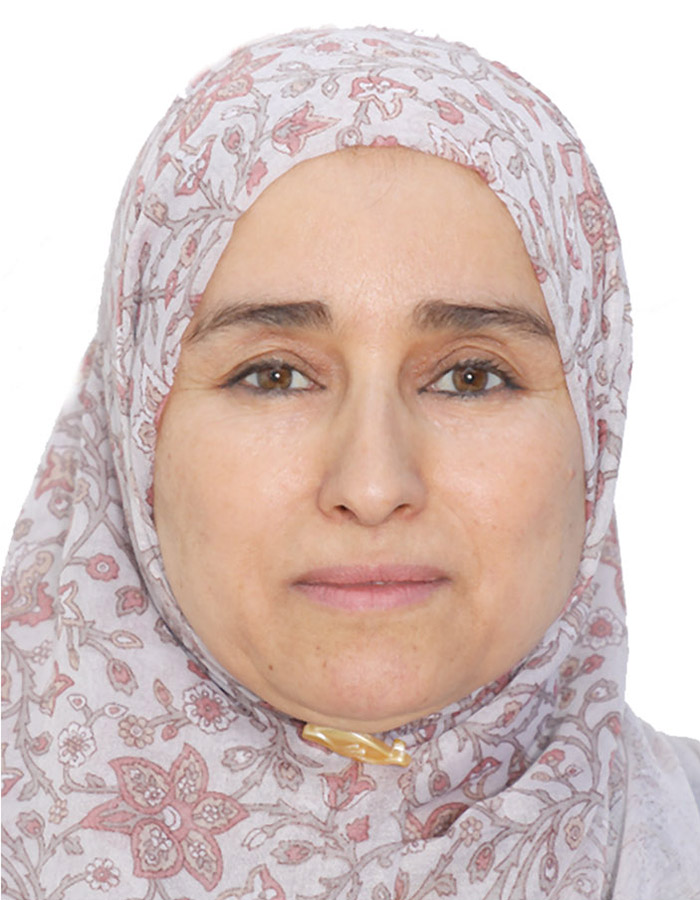
M. BEDDAL Dalila

MCB

Directory of teachers

Department

Departement of Agricultural sciences

Research Interests

hydrologie l'eau dans l'environnement Gestion des ressources en eau superficielles modélisation hydrologique bioclimatologie Agrométéorologie changements climatiques Gestion des bassins versants irrigation et drainage

Contact Info

University of M'Sila, Algeria

On the Web:

  • Google Scholar N/A
  • ResearchGate
    ResearchGate N/A
  • ORCID N/A
  • SC
    Scopus N/A

Recent Publications

2025-11-18

organizing member

in aknowledgment of valuable contributions as a mumber of the organizing commitee
Citation

M. BEDDAL Dalila, (2025-11-18), "organizing member", [national] English Medium Instruction (EMI) , msila university

2025-02-19

encadrement etudiant cinq étoiles

encadrement etudiant cinq (05) étoiles, les étudiants concernés sont: GHADBANE Abir et BOUDHINA Abla spécialité science du sol (MSS) dans le département des sciences agronimiques
Citation

M. BEDDAL Dalila, (2025-02-19), "encadrement etudiant cinq étoiles", [national] msila university

2024-12-16

Evaluation de la qualité physicochimique et bactériologique des eaux usées épurées de la STEP Msila

Les eaux usées dans les zones urbaines contiennent une quantité importante de polluants provenant des eaux usées domestiques, industrielle. Pour protéger simultanément la santé publique des habitants et préserver l’écosystème naturel ; l’installation d’une station d'épuration joue le rôle d'assainir ces eaux usées avant de les rejeter dans le milieu naturel et leur réutilisation dans l’irrigation des espaces verts et des terres agricoles. La STEP de M’sila mise en service en 2013 traite quotidiennement 48000 m3 d’eau usée provenant de l’agglomération de M’sila et sa zone industrielle. L’objectif de ce travail est de caractériser la qualité physico-chimique et bactériologique des eaux usées épurées de la Station de M’sila afin d'évaluer l'efficacité des processus utilisés dans cette station, y compris le processus de boues activées. Les résultats obtenus révèlent une efficacité de dégradation de la matière organique (MES de 03 mg/l, DBO5 de 07mg/l et DCO de 45 mg/l) par rapport aux normes Algériennes. Les résultats bactériologiques montrent l’absence des anaérobies sulfito-rédacteurs, et une charge très forte en germes totaux, en coliformes avec présence de Staphylococcus Aureus. De plus, on a noté de grandes quantités de métaux lourds. A cet effet, des traitements complémentaires doivent être envisagés pour réduire considérablement les métaux lourds et la charge bactériologique afin de protéger la santé publique contre les maladies à transmission hydrique.
Citation

M. BEDDAL Dalila, (2024-12-16), "Evaluation de la qualité physicochimique et bactériologique des eaux usées épurées de la STEP Msila", [international] natural risks, urban territory managment and analysis tools , msila university

assessing the effectivness of 1D hydraulic models in flood protection . Acase study of wadi ksob

Wastewater in urban areas contains large quantities of pollutants from domestic and industrial wastewater. To protect simultaneously the public health of habitants and preserve the natural ecosystem, the installation of a wastewater treatment station plays the role of purifying this wastewater before rejected it into the natural environnent and reusing it to irrigate green spaces and agricultural fields. The M'sila station, has been started to work since 2013. It treats 48,000 m3 of wastewater per day from M'sila’s urban area and its industrial zone. The aim of this work is to characterize the physico-chemical and bacteriological quality of the treated wastewater from the M'sila station in order to assess the efficiency of the processes used, including the activated sludge process. The obtained results reveal an efficiency of organic matter degradation (Suspended matter of 03 mg/l, DBO5 of 07mg/l and DCO of 45 mg/l) in relation to Algerian standards. The bacteriological results show the absence of sulfito-redacting anaerobes and a very high load of total germs and coliforms, with the presence of Staphylococcus Aureus. In addition, large quantities of heavy metals were found. As results, additional treatments are required to protect the public health against water
Citation

M. BEDDAL Dalila, (2024-12-16), "assessing the effectivness of 1D hydraulic models in flood protection . Acase study of wadi ksob", [international] natural risks, urban territory managment and analysis tools , msila university

Evaluation de la qualité physico-chimique et bactériologique des eaux usées épurées de la STEP de M'sila

Les eaux usées dans les zones urbaines contiennent une quantité importante de polluants provenant des eaux usées domestiques, industrielle. Pour protéger simultanément la santé publique des habitants et préserver l’écosystème naturel ; l’installation d’une station d'épuration joue le rôle d'assainir ces eaux usées avant de les rejeter dans le milieu naturel et leur réutilisation dans l’irrigation des espaces verts et des terres agricoles. La STEP de M’sila mise en service en 2013 traite quotidiennement 48000 m3 d’eau usée provenant de l’agglomération de M’sila et sa zone industrielle. L’objectif de ce travail est de caractériser la qualité physico-chimique et bactériologique des eaux usées épurées de la Station de M’sila afin d'évaluer l'efficacité des processus utilisés dans cette station, y compris le processus de boues activées. Les résultats obtenus révèlent une efficacité de dégradation de la matière organique (MES de 03 mg/l, DBO5 de 07mg/l et DCO de 45 mg/l) par rapport aux normes Algériennes. Les résultats bactériologiques montrent l’absence des anaérobies sulfito-rédacteurs, et une charge très forte en germes totaux, en coliformes avec présence de Staphylococcus Aureus. De plus, on a noté de grandes quantités de métaux lourds. A cet effet, des traitements complémentaires doivent être envisagés pour réduire considérablement les métaux lourds et la charge bactériologique afin de protéger la santé publique contre les maladies à transmission hydrique.
Citation

M. BEDDAL Dalila, (2024-12-16), "Evaluation de la qualité physico-chimique et bactériologique des eaux usées épurées de la STEP de M'sila", [international] natural risks, urban territory managment and analysis tools , msila university

2024-10-15

Bioclimatologie

Le milieu physique qui nous environne influence le comportement biologique des êtres qui y vivent ; et inversement, ces derniers, à leur tour, peuvent modifier certains paramètres à leur environnement. Il s’établit donc une succession d’interaction représentée par les différents états d’équilibre entre l’organisme et le climat ce qui constitue le bioclimat.
Une zone bioclimatique se caractérise par certains paramètres physiques du milieu (rayonnement solaire, pluie, température, humidité de l’air,…) et par les caractéristiques
de ces communautés végétales et animales qui s’y développent. Ainsi, les interactions entre les facteurs climatiques déterminent un état d’équilibre qui évolue dans le temps
(journée, mois, cycle) ; est représenté par le climat permettant à l’organisme vivant de se développer et de se multiplier.
Citation

M. BEDDAL Dalila, (2024-10-15), "Bioclimatologie", [national] msila university

2024-10-14

Comparative soft computing approaches for discharge modeling in a semi-arid region: Case study of some wadis of the Macta basin (Northweste of Algeria)

In North Africa, water resources are precious and scarce due to the insufficiency of perpetual wadis and variability over time between periods of extreme rain and desiccation. As a result, The development of accurate discharge models can be helpful in the simulation and the prediction in several water resources fields such as management and planning of water resources. The usage of soft computing techniques has become necessary to solve problems associated with non linear methods. The main objective of this work is to simulate the discharge of some wadis of Macta basin by using two different data-driven models, namely BPNN and MLR widely applied for discharge simulation in hydrology. The Macta basin is located in northwestern of Algeria, It covers an area of approximately 14,389 km2.The Macta watershed is composed of sixteen (16) sub-basins drained by temporary wadis of total length equal to 8115 Km. The climate of the Macta basin is semi-arid. Different combinations were attempted to simulate the target variable (Q) which is monthly hydrometric data recorded between July 1983 and May 2016. The climatological inputs data are rainfall (P) and reference evapotranspiration (ETo) on a monthly scale including different lag time series of input data (P, Pt–1, ETo, ETot–1, Qt–1). The outcomes for BPNN and MLR were evaluated using three statistical measurements: Nash–Sutcliffe efficiency coefficient (NSE), the coefficient of correlation (R) and root mean square error (RMSE). The results revealed that the BPNN model exhibited good performance and accuracy in the simulation of discharge during both training and validation phases. The outcomes demonstrated that BPNN-4 is the best performing model with the values of 0.885, 0.941 and 0.05 for NSE, R and RMSE, respectively. The highest NSE and R values and the lowest RMSE for both training and validation are an indication of the best network. Therefore, the BPNN model provides better prediction due to its capability to deal with complex nonlinearity procedures. However, the MLR model presents a low predictive accuracy because of the linearity of the input–output relation.
Citation

M. BEDDAL Dalila, BAAHMED Djelloul, , (2024-10-14), "Comparative soft computing approaches for discharge modeling in a semi-arid region: Case study of some wadis of the Macta basin (Northweste of Algeria)", [national] eau, environnement et énergie renouvelable , msila university

2024-10-13

comparative soft computing approaches for discharge modelling in a semi-arid region, case study of some wadis of Macta basinof

In North Africa, water resources are precious and scarce due to the insufficiency of perpetual wadis and variability over time between periods of extreme rain and desiccation. As a result, The development of accurate discharge models can be helpful in the simulation and the prediction in several water resources fields such as management and planning of water resources. The usage of soft computing techniques has become necessary to solve problems associated with non linear methods. The main objective of this work is to simulate the discharge of some wadis of Macta basin by using two different data-driven models, namely BPNN and MLR widely applied for discharge simulation in hydrology. The Macta basin is located in northwestern of Algeria, It covers an area of approximately 14,389 km2.The Macta watershed is composed of sixteen (16) sub-basins drained by temporary wadis of total length equal to 8115 Km. The climate of the Macta basin is semi-arid. Different combinations were attempted to simulate the target variable (Q) which is monthly hydrometric data recorded between July 1983 and May 2016. The climatological inputs data are rainfall (P) and reference evapotranspiration (ETo) on a monthly scale including different lag time series of input data (P, Pt–1, ETo, ETot–1, Qt–1). The outcomes for BPNN and MLR were evaluated using three statistical measurements: Nash–Sutcliffe efficiency coefficient (NSE), the coefficient of correlation (R) and root mean square error (RMSE). The results revealed that the BPNN model exhibited good performance and accuracy in the simulation of discharge during both training and validation phases. The outcomes demonstrated that BPNN-4 is the best performing model with the values of 0.885, 0.941 and 0.05 for NSE, R and RMSE, respectively. The highest NSE and R values and the lowest RMSE for both training and validation are an indication of the best network. Therefore, the BPNN model provides better prediction due to its capability to deal with complex nonlinearity procedures. However, the MLR model presents a low predictive accuracy because of the linearity of the input–output relation.
Citation

M. BEDDAL Dalila, (2024-10-13), "comparative soft computing approaches for discharge modelling in a semi-arid region, case study of some wadis of Macta basinof", [national] eau, environnement et énergie renouvelable , université de M'sila

2024-05-15

COMPARATIVE STUDY OF DIFFERENT METHODS FOR ESTIMATING EVAPOTRANSPIRATION IN ARID ZONES (CASE OF M’SILA REGION) ETUDE COMPARATIVE DES DIFFERENTES METHODES D’ESTIMATION DE L’EVAPOTRANSPIRATION EN ZONE ARIDE (CAS DE LA REGION DE M’SILA)

Sustainable management of water resources requires a good command the terms used in the agricultural balance. Evapotranspiration is a major factor in water lose. Estimating this parameter is necessary to understand the water requirements of plants and crops, and consequently to program the irrigation schedule. The aim of this work is to test the effectiveness of the three (03) empirical formulas of Thornthwaite, Turc, and Penman and Monteith in estimating potential evapotranspiration at M'sila region, located in the arid bioclimatic zone, during a period over 28-years (1988/89 to 2015/16). These formulas results were been compared to the observed data of Piche's instrument. On an annual scale, the results show that Penman's formula is the closest to Piche's, with a maximum relative deviation of (- 13.6 to 11.2) %. On a monthly scale, the results showed a good agreement by Penman, with a very high correlation coefficient (r = 0.97) and a relative deviation of up to 4.7%. On a monthly scale, all PTE curves (Piche, Thornthwaite, Penman-Monteith and Turc) show similar trends, with a correlation coefficient correlation coefficient (r > 0.9). However, the best correlation is obtained by Penman, with a very high correlation coefficient (r = 0.97). The Thoronthwaite method is the weakest, while the Turc method occupies an intermediate position. This is due to the number and nature of the climatic parameters included by each formula. The empirical formula therefore proved its effectiveness for estimating ETP in the M'sila region.

Keywords: potential evapotranspiration, estimation, empirical formula, arid, climate.
Citation

M. BEDDAL Dalila, KABACHE Zakia, RAHABI Hadjer, , (2024-05-15), "COMPARATIVE STUDY OF DIFFERENT METHODS FOR ESTIMATING EVAPOTRANSPIRATION IN ARID ZONES (CASE OF M’SILA REGION) ETUDE COMPARATIVE DES DIFFERENTES METHODES D’ESTIMATION DE L’EVAPOTRANSPIRATION EN ZONE ARIDE (CAS DE LA REGION DE M’SILA)", [national] Geoscience: WATER- SOIL: ECONOMICAL AND ENVIRONMENTAL IMPACT , Oum El Bouaghi

2023-12-17

algerian scientific publication and peer review: Status quo and future directions

La recherche se construit, dans un collectif de savoirs partagés et en permanence élargis grâce aux publications. La publication scientifique est une étape importante de l’activité du chercheur pour rendre visible ses travaux et diffuser des connaissances nouvelles d’une part, ou d’autre part garantir la paternité d’un résultat, obtenir des financements pour sa recherche, ou encore évoluer tout au long de sa carrière. La publication d’un article scientifique passe par plusieurs phases qui sont la rédaction, choix du journal ou de la revue de publication, soumission, avis du journal. Quelle que soit sa discipline, publier est incontournable pour un scientifique aujourd'hui. Aussi, la recherche dans le domaine technique n’est pas aisée qui nécessite l’originalité du travail en question, alors que les règles de publication sont souvent implicites. Cependant, la méthode de rédaction d’un article scientifique constitue la principale étape de réussite sa publication. L’objectif de ce travail est de maitriser les règles de rédaction des différentes sections d’un projet d’article scientifique technique pour garantir sa publication. Un autre objectif est comment choisir le journal cible et comprendre comment sont évalués les articles soumis pour publication.
Citation

M. BEDDAL Dalila, (2023-12-17), "algerian scientific publication and peer review: Status quo and future directions", [national] publier un article scientifique : etapes de rédaction et défis de publication , university of Msila

2023-06-18

comment réussir sa soutenance: Méthodes et techniques

Objectif :
Donner aux étudiants en fin d’étude (Master II) des compétences techniques, méthodologiques et psychologiques avant et au cours de la présentation pour réussir la soutenance.
Axes :
- Comment préparer un support de présentation orale.
- Fournir aux étudiants des compétences techniques de présentation.
- Comment gérer le stress avant et durant la soutenance.
- Conseils et orientations.
- Réponses aux questions des étudiants.
Citation

M. BEDDAL Dalila, (2023-06-18), "comment réussir sa soutenance: Méthodes et techniques", [national] comment réussir sa soutenance: Méthodes et techniques , university of Msila

2023-05-01

Investigation for Flood Flow quantification of Porous Asphalt with Different Surface and Subsurface Thickness

Permeable pavement can be considered one of the most successful alternatives solution to traditional asphalt,
which industrially widely used due to their ability to allow rainwater or water from another source to
leak through the earth surface to a tank below the surface; and that can be used for water-saving due lack
of rains or to increase groundwater, as well as for irrigation. Another advantage that these permeable
pavements may offer is their ability to remove contaminants that affect vehicle traffic, by moving across the
pavement to the drainage system. The study aims to select the associations between the rainfall’s intensity,
the quantity of surface and subsurface runoff depending on the open-graded material and computational
models to evaluate the porous pavements design. In this study, three aggregate distributions which are
minimum, medium and maximum specifications are used. The results show that the medium gradation has
met the requirements, and it is considered the best gradient, crumbed rubber are used. The optimal binder
content satisfy the requirements is 6.3% for the porous asphalt mixtures. Nevertheless, when crumbed
rubber is used with (10, 15 and 20)%. Crumb rubber percent used is 15% by the weight of Asphalt cement
utilised for porous mix. The experimental results are utilised to produce mathematic models that estimated
the surface and subsurface runoff for asphalt pavement. By the benefit of non-linear regression modelling
using (SPSS) statistics software and making several equations to express those events to extend the software
application, to sum up, cases that were not experimentally studied.
Citation

M. BEDDAL Dalila, Ahmed Abdulhamid Mahmoud, Marie Thérèse Marame Mbengue, Saddam Hussain, Musbahu Aminu Abdullahi, Sani I. Abba, , (2023-05-01), "Investigation for Flood Flow quantification of Porous Asphalt with Different Surface and Subsurface Thickness", [national] Knowledge-Based Engineering and Sciences , SPRINGERNATURE , CAMPUS, 4 CRINAN ST, LONDON, ENGLAND, N1 9XW

2022

EVALUATION DES FONCTIONS OBJECTIVES D’UN MODELE NEURONAL RECURRENT BPNN A L’ESTIMATION DES DEBITS LIQUIDES MENSUELS DE QUELQUES SOUS BASSINS DE LA MACTA, NORD OUEST D’ALGERIE

L’eau constitue une ressource précieuse, un enjeu de civilisation et un potentiel économique considérable de développement durable. Avec la puissance de l’outil informatique et de la complexité des phénomènes hydrologiques, les recherches se sont approfondies vers les réseaux de neurones artificiels basés sur un ensemble de concepts hydrologiques exprimés en langage mathématique et reliés entre eux spatialement et temporellement. Les réseaux de neurones artificiels sont utilisés dans la résolution des problèmes liés à la gestion quantitative et qualitative rationnelle et durable des ressources en eau. L’objectif du travail est d’évaluer la performance et la robustesse des modèles à base des réseaux de neurones artificiels types réccurrents BPNN pour simuler les débits liquides des oueds de la Macta. Ce type de réseau récurrent est adaptés pour estimer des processus et des systèmes dynamiques et non linéaires. Le grand bassin versant de la Macta (14389 Km2) situé au Nord-Ouest de l’Algérie septentrionale est caractérisé par un climat semi-aride, est marquée par une variabilité spatio-temporelle du régime hydro-climatique. L’analyse statistique de cette variabilité est traduite par une augmentation de la température sans rupture recensée durant la période d’étude (1983/84- 2015/16) et est accompagnée d’une augmentation du régime pluviométrique durant les années 2000. Par conséquence, les débits des oueds de la Macta connaissent une variabilité considérable et instable. Quatre (04) combinaisons de modèles BPNN ont été appliqué pour simuler le débit liquide observé des oueds de la Macta dont les variables d’entrée sont P, ET0 sous différentes combinaisons alors que la variable sortie est le débit simulé Qt .Les résultats montrent que l’ensemble des séries temporelles étudiées s’ajustent bien avec les 04 combinaisons du modèle BPNN. La meilleure combinaison est celle BPNN4 qui tient compte de la combinaison des variables d’entrée P_t,〖ET0〗_(t-1),Q_(t-1) dont les critères statistiques r et NSE indiquent un niveau élevé de performance durant les deux périodes de calage (0,81 et 95% respectivement) et de validation (0,7 et 91% respectivement). Finallement, les modèles neuronaux récurrents BPNN sont très performants pour simuler les débits liquides des oueds de la Macta à cause de leur aptitude à capturer l’effet stochastique de la non linéarité de la relation pluie-débit sans rentrer dans le processus hydrologique.
Citation

M. BEDDAL Dalila, BAAHMED Djelloul, , (2022), "EVALUATION DES FONCTIONS OBJECTIVES D’UN MODELE NEURONAL RECURRENT BPNN A L’ESTIMATION DES DEBITS LIQUIDES MENSUELS DE QUELQUES SOUS BASSINS DE LA MACTA, NORD OUEST D’ALGERIE", [international] 1st international conference on water and environnment , Mascara

Soft computing models to discharge modeling in a Semiarid Area: case study of Macta wadis ( northwestern Algeria)

The evaluation and management of water resources and their quantity have become the primary focus of researchers in the hydro-environmental field. This especially applies in semi-arid regions that are endowed with limited economic resources. In North Africa, water resources are precious and scarce due to the insufficiency of perpetual wadis and variability over time between periods of extreme rain and desiccation. As a result, The development of accurate discharge models can be helpful in the simulation and the prediction in several water resources fields such as management and planning of water resources. However, complex processes associated with the hydro-meteorological variables, such as non-stationarity, non-linearity, and randomness, make the streamflow simulation chaotic. Therefore, the usage of soft computing techniques has become necessary to solve problems associated with non linear methods. The main objective of this work is to simulate the discharge of some wadis of Macta basin by using two different data-driven models, namely BPNN and MLR widely applied for discharge simulation in hydrology. Furthermore, the main advantages of BPNN are the simplicity of its architecture and easy construction of the mathematical model in addition to the fact that it is characterized by rapid processing and possesses strong nonlinear mapping capabilities. For this purpose, The Macta basin is located in northwestern of Algeria, It covers an area of approximately 14,389 km2.The Macta watershed is composed of sixteen (16) sub-basins drained by temporary wadis of total length equal to 8115 Km. The climate of the study area is semi-arid and subject to the influence of the sea to the north and the continents to the south. The Macta watershed occupies the western part of the Tellian Atlas. The geology of the grounds is very varied ranging from the primary age to the Quaternary, among which dominate the marly and limestone facies. The most dominant vegetation cover is of the temporary type (58% of the total area) concentrated in the interior plains of Sidi Belabbes, Ghriss and the large irrigated areas (Habra, Sig). Different combinations were attempted to simulate the target variable (Q) which is monthly hydrometric data recorded between July 1983 and May 2016. The climatological inputs data are rainfall (P) and reference evapotranspiration (ETo) on a monthly scale including different lag time series of input data (P, Pt–1, ETo, ETot–1, Qt–1). The outcomes for BPNN and MLR were evaluated using three statistical measurements: Nash–Sutcliffe efficiency coefficient (NSE), the coefficient of correlation (R) and root mean square error (RMSE). The results revealed that the BPNN model exhibited good performance and accuracy in the simulation of discharge during both training and validation phases. The outcomes demonstrated that BPNN-4 is the best performing model with the values of 0.885, 0.941 and 0.05 for NSE, R and RMSE, respectively. The highest NSE and R values and the lowest RMSE for both training and validation are an indication of the best network. Therefore, the BPNN model provides better prediction due to its capability to deal with complex nonlinearity procedures. However, the MLR model presents a low predictive accuracy because of the linearity of the input–output relation.
Citation

M. BEDDAL Dalila, (2022), "Soft computing models to discharge modeling in a Semiarid Area: case study of Macta wadis ( northwestern Algeria)", [international] the 2nd International Conference "Geosciences & Environment - ICGSE2022" , Mascara

2020

Streamflow prediction using data-driven models: Case study of Wadi Hounet, northwestern Algeria

Streamflow modelling is a very important process in the management and planning of water resources. However, complex processes associated with the hydro-meteorological variables, such as non-stationarity, non-linearity, and randomness, make the streamflow prediction chaotic. The study developed multi linear regression (MLR) and back propagation neural network (BPNN) models to predict the streamflow of Wadi Hounet sub-basin in north-western Algeria using monthly hydrometric data recorded between July 1983 and May 2016. The climatological inputs data are rainfall (P) and reference evapotranspiration (ETo) on a monthly scale. The outcomes for both BPNN and MLR models were evaluated using three
statistical measurements: Nash–Sutcliffe efficiency coefficient (NSE), the coefficient of correlation (R) and root mean square error (RMSE). Predictive results revealed that the BPNN model exhibited good performance and accuracy in the prediction of streamflow over the MLR model during both training and validation phases. The outcomes demonstrated that
BPNN-4 is the best performing model with the values of 0.885, 0.941 and 0.05 for NSE, R and RMSE, respectively. The Streamflow modelling is a very important process in the management and planning of water resources. However, complex processes associated with the hydro-meteorological variables, such as non-stationarity, non-linearity, and randomness,
make the streamflow prediction chaotic. The study developed multi linear regression (MLR) and back propagation neural network (BPNN) models to predict the streamflow of Wadi Hounet sub-basin in north-western Algeria using monthly hydrometric data recorded between July 1983 and May 2016. The climatological inputs data are rainfall (P) and reference evapotranspiration (ETo) on a monthly scale. The outcomes for both BPNN and MLR models were evaluated using three statistical measurements: Nash–Sutcliffe efficiency coefficient (NSE), the coefficient of correlation (R) and root mean square error (RMSE). Predictive results revealed that the BPNN model exhibited good performance and accuracy in the
prediction of streamflow over the MLR model during both training and validation phases. The outcomes demonstrated that BPNN-4 is the best performing model with the values of 0.885, 0.941 and 0.05 for NSE, R and RMSE, respectively. The highest NSE and R values and the lowest RMSE for both training and validation are an indication of the best network.
Therefore, the BPNN model provides better prediction of the Hounet streamflow due to its capability to deal with complex nonlinearity procedures. highest NSE and R values and the lowest RMSE for both training and validation are an indication of the best network. Therefore, the BPNN model provides better prediction of the Hounet streamflow due to its capability to deal with complex nonlinearity procedures.
Citation

M. BEDDAL Dalila, (2020), "Streamflow prediction using data-driven models: Case study of Wadi Hounet, northwestern Algeria", [national] water and land development , Polish Academy of Sciences

← Back to Researchers List